
Knox County Arrest Log Sources
Knox County posts no complete official booking log online. The Knox County Sheriff's Office press archive runs back years by date. It only carries selected announcements, though. Big operations may earn a release naming several arrests and agencies. A routine booking might never appear there. For current custody, the sheriff's Inmate Roster gateway points readers to its mobile app.
Among news sources, the Galesburg Community News crime section offers the strongest recurring coverage. It publishes weekly Galesburg Police blotters plus separate Knox County charges and dispositions reports. Illinois Weeklies contributes rural public-record roundups. WGIL covers selected cases as news. None of these are government booking databases. Incidents get missed, date windows vary, and a court event may run after the person has already left jail.
Important: A weekly article is not a live jail roster and never lists everyone arrested, so confirm custody with the sheriff and case status with the court.
Reading Knox County Police Blotters
Match each source to the record it truly holds. Check the publication date and reporting window first. The incident itself may fall earlier. A court roundup can mention a warrant served, a new charge, or a disposition without touching on the original jail stay at all. For faster answers about who is in custody right now, the Knox County 24 Hour Arrests page maps the current-custody route; these steps serve the longer trail.
- Open the sheriff app through the official roster gateway to see whether the person appears in current Knox County custody.
- Search the Galesburg weekly police blotter for the incident window, not just the article's publication day.
- Check the Knox County charges and dispositions roundup for a later filing, warrant service, plea, dismissal, or other court result.
- For rural communities, review Illinois Weeklies while keeping its weekly and selective scope in mind.
- Request the arrest or booking record from the agency that created it when online sources are incomplete.
This order guards against a common mistake. A missing weekly story proves nothing about whether an arrest happened. An old blotter entry proves nothing about confinement either. Current county custody, the arresting agency's report, and the Circuit Clerk's case file each answer a different question.
Knox County Arrest Entry Fields
The Galesburg Police blotter uses a defined week. Its entries may carry a name, age, published address, charge, incident date, time, and location. The Knox County court roundup adds later legal events like warrants served and dispositions. Never merge those fields into an invented county booking record. Read the label beside each fact. It matters.
| Field | What it can mean |
|---|---|
| Name and age | The identifying details the news source chose to publish, subject to correction. |
| Incident date and place | When and where the reported police contact occurred, which may differ from booking time. |
| Charge | An charge recorded at that stage. |
| Arresting agency | The police or sheriff's office most likely to hold the incident report. |
| Warrant served | A court order reported as executed; it does not by itself show current custody. |
| Disposition | The later court result, which can differ from the charge first reported. |
| Photo | No recurring official booking-photo feed was verified in the reviewed blotters. |
A county booking record may hold more data. The public browser gateway documents no field list, though. Secondary pages hint that identifiers and physical descriptors appear. Those hints are not certified sheriff-app fields, though. Ask KCSO for the actual record whenever exact booking data matters. The source page for this weekly blotter shows the layout of a date-bounded local report.
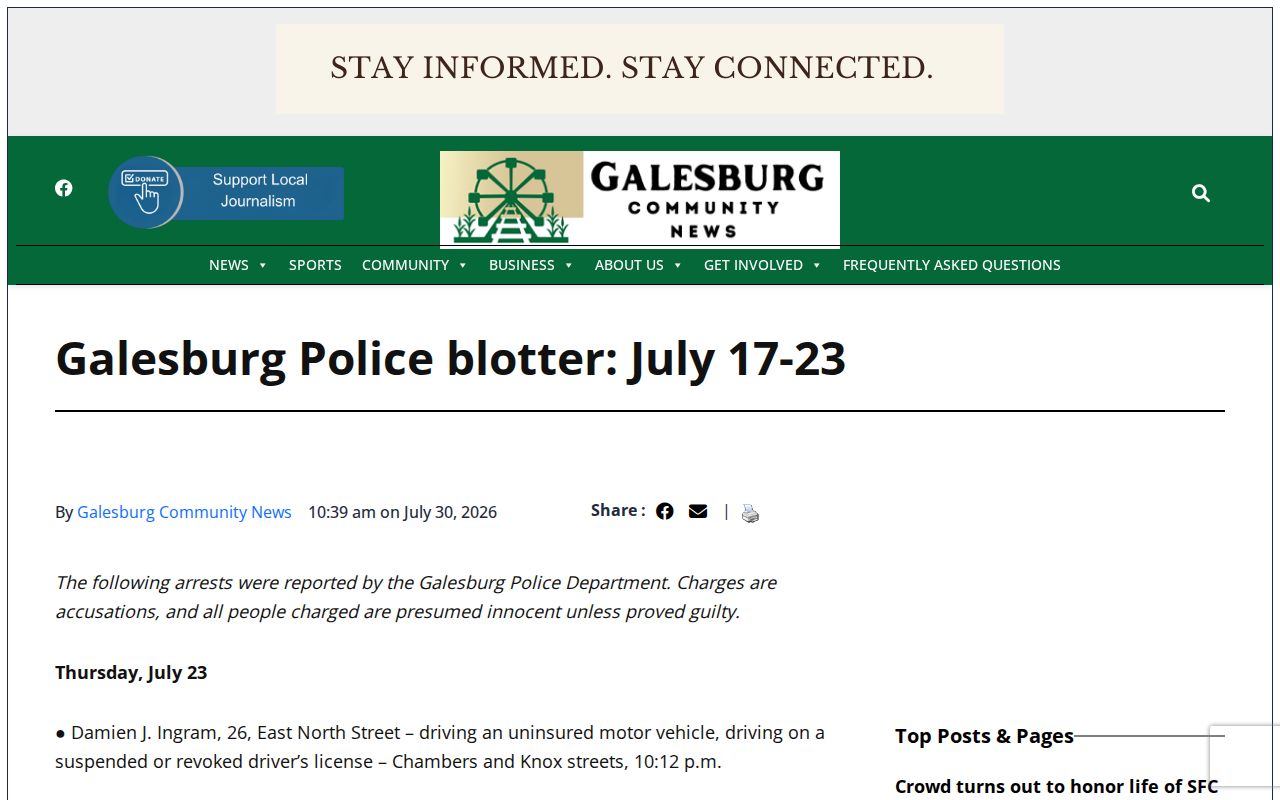
That page is useful for its reporting format alone, not as proof of anyone's current custody.
Weekend Knox County Arrest Reports
KCSO states no weekend or holiday refresh rule for a public booking log. Intake, identity checks, bond processing, transfers, and data syncing can all push the visible entry far past the arrest itself. Weekly news schedules add another lag. A blotter may group several days even though officers filed each report separately.
Never assume a Monday article covers only Monday arrests. Read the window in the headline, then compare the named event date. When the question is urgent and involves one known person, the official mobile roster beats waiting on the next news cycle. KCSO's general number, 309-343-9151, works too. Office hours differ across official county pages, so confirm them before any visit.
Weekend check: Knox County publishes no rule promising a booking will post within a set number of hours, and a blank app or news search does not mean a release.
Knox County Arrest Log Archives
No public KCSO schedule says how long a booking entry, roster line, or booking photograph stays online. A page's removal reflects its publisher. Its disappearance proves little. Knox County keeps the substance in the incident report, booking record, court file, and archived public record. Each of those follows its own schedule.
Older arrests take a records request. Send a narrow Illinois Freedom of Information Act request to whichever office holds the record. Be specific. Name the person, date range, arresting agency, any report or booking number, and the exact item sought. For KCSO material, the county names State's Attorney Jeremy Karlin as its FOIA officer. Galesburg works differently. A city police report goes through the municipal records and FOIA route. Ask whether the record is still active. It may have been disposed of under an approved schedule, or it may sit in an archive.
The Illinois Local Records Commission guidance explains that local agencies operate under approved retention authority. Nothing vanishes at will. Historical Knox County holdings can also be discussed with the courthouse or Western Illinois University's IRAD repository. IRAD does not list jail booking photos. Court files and jail booking records remain distinct.
Note: State and local retention rules govern official records; a newspaper's archive depth does not set the sheriff's disposal schedule.
Galesburg Arrest News Patterns
Galesburg Community News runs two different streams. The police blotter gathers selected Galesburg Police activity for one stated week. The charges and dispositions report follows Knox County court activity instead, so it can show what happened after the first report. The split matters locally. The sheriff posts no complete multi-day booking archive. The Knox County charges and dispositions source shows that court-side bridge at work.
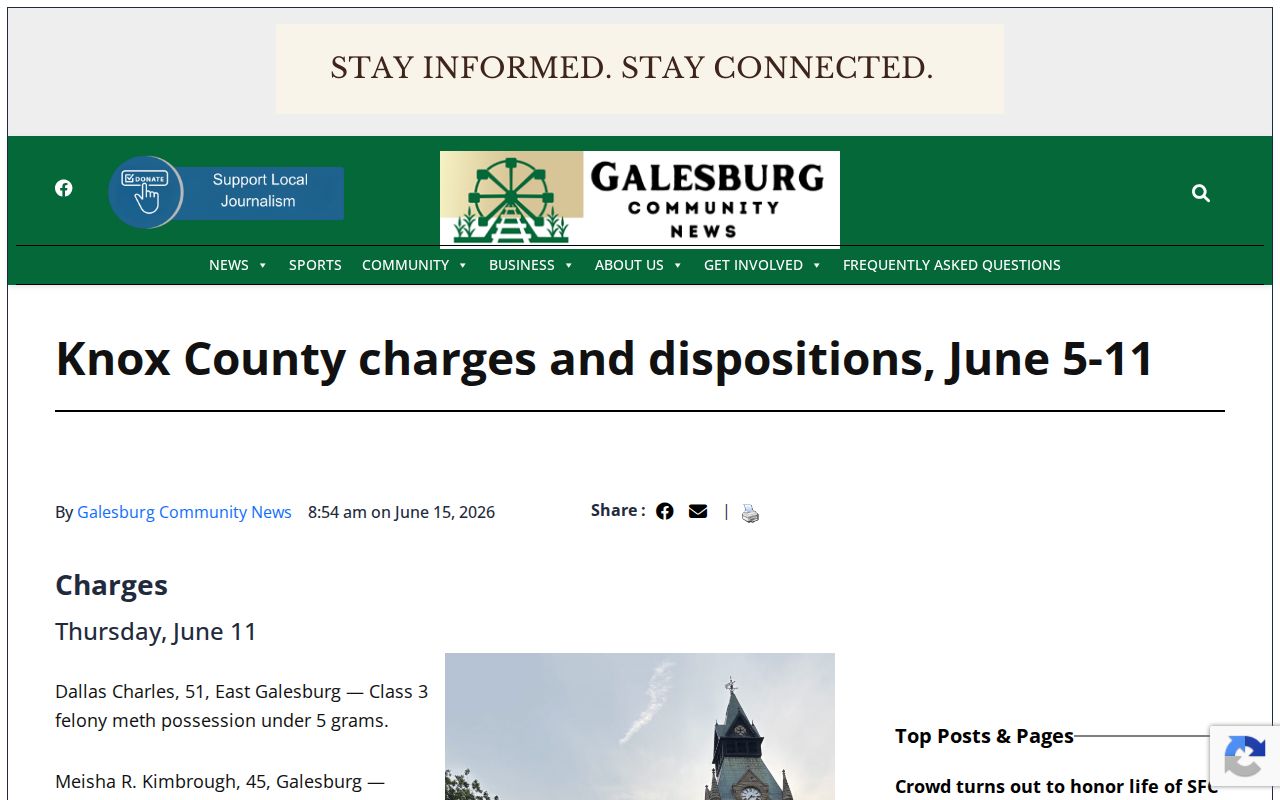
A later report can add court context. It is still not the certified docket. WGIL takes a third approach, publishing selected narrative stories with court context rather than a routine roster. Illinois Weeklies serves rural readers through grouped public-record reports. Each outlet fills a gap, yet none works as a complete Knox County arrest log.
Rural Knox County Arrest Coverage
A Galesburg-centered blotter can miss smaller towns. The Illinois Weeklies public-record roundup provides a weekly lens that may include Knox County rural police reports. It offers reach, not live custody status.
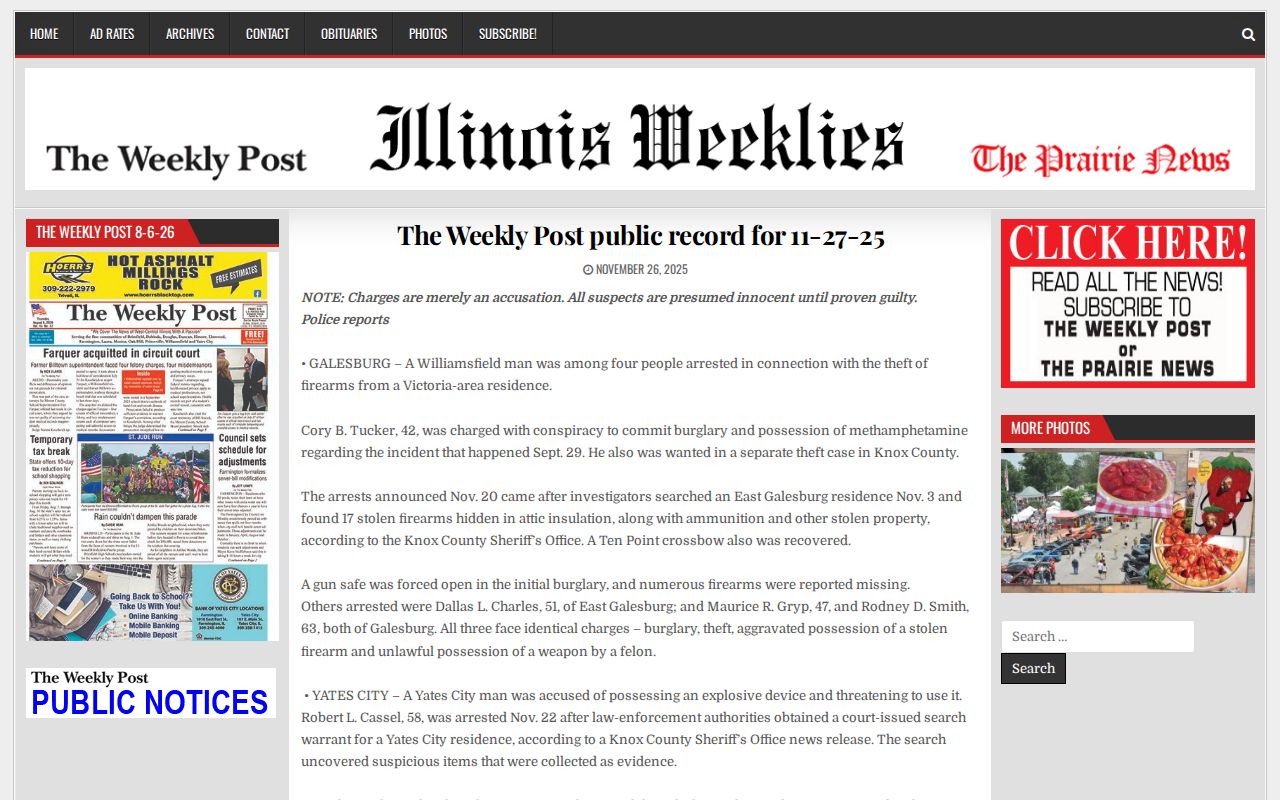
The weekly roundup groups public-record items into one post. Anything in it should be checked against the arresting agency and the court. Abingdon and Knoxville run no recurring city arrest feed. Their incident records stay with the city police or municipal custodian. Someone held in county custody is checked through KCSO. That agency split explains why one search rarely produces a complete multi-day view of Knox County arrests.
After Knox County Arrest Reports
An arrest log captures one point in time. Booking records cover the jail stage. The current roster reflects county custody, while a court docket tracks filings, hearings, pleas, dismissals, and judgment. These sources can disagree without any one of them being false, because each describes a different stage.
- Booking
- The jail intake process that records identity, charges, and custody information.
- Bond
- The court-set terms that may allow release while a case is pending.
- Disposition
- The court's outcome for a charge, such as dismissal, plea, or judgment.
- Expungement
- A legal process that may erase eligible records under an entered court order.
For the case after booking, use the Knox County Circuit Clerk or the Ninth Judicial Circuit's Knox County access routes. A jail release does not end the case. A case outcome does not erase old news copies. Charges can be reduced or dismissed as matters move forward. Each source answers a different question.